
F1's 2026 emergency fix, explained with data
What forced the FIA to rewrite the 2026 rules before the Miami GP

Formula 1 changes its rules on a regular basis. Sometimes the changes are small. Sometimes they rewrite almost everything. The 2026 regulations are the biggest overhaul since the hybrid era started in 2014.
The goals were clear. First, make the technology more relevant to road cars. Second, reduce the sport’s environmental impact. Third, make it easier for new manufacturers to join, by removing some of the most complex and expensive components from the power unit.
One of those components was the MGU-H, the motor that recovered energy from exhaust heat and fed it back into the system. It was brilliant engineering, but it had almost no equivalent in a normal car, it cost a fortune to develop and it was one of the main reasons new engine suppliers were reluctant to enter the sport. So it was cut.
In its place, the regulations put much more weight on the MGU-K, the electric motor connected to the drivetrain that recovers kinetic energy under braking and stores it in the battery. The internal combustion engine was dialled back, the electric side was boosted, and the fuel switched to biofuel. The target was a near 50/50 split between thermal and electric power.
The problem is that nobody (a part from Verstappen, apparently) fully anticipated was how a racing car would actually behave when its battery kept running out mid-straight, and how the system would respond when it needed to recharge.
By the third race of the season, it was clear that something needed to change. The FIA acted before the Miami GP, rewriting part of the rules between race weekends.
This post tries to explain what went wrong and what the fix actually does.
A new power unit, a new set of rules
The 2026 rules changed almost everything at once. Here is what actually changed.
The power unit
The 1.6-litre V6 turbocharged engine stays, but the balance of power shifts significantly. The Internal Combustion Engine (ICE) drops from around 600 kW to 400 kW. The MGU-K, that acts as both a motor under acceleration and a generator under braking, goes from 120 kW to 350 kW, nearly three times as much. The result is a near 50/50 split between thermal and electric power.
The MGU-H is gone. With it goes the ability to keep the turbo spinning on demand. Turbo lag is back. To compensate, drivers have to stay in lower gears through corners to keep engine revs high and the turbo ready. It also changes how race starts work: electric power is not available below 50 km/h, so teams use a pre-start sequence to spin the turbos up before the lights go out.
The battery holds 4 MJ. The system has to recharge constantly, not just under braking. When the battery is low, the power unit starts harvesting energy even while the driver has the throttle fully open. The car slows on the straight, not because the driver lifted, but because the system is recharging. This is called superclipping, and it turned out to be a bigger problem than anyone expected. More on that in the next section.
Active aerodynamics
DRS is gone. In its place, both the front and rear wings can be opened on straights. In Corner Mode (or Z-Mode), the wings generate maximum downforce. On straights, they switch to Straight Mode (or X-Mode), flattening out to reduce drag. This is available to every driver on every lap: without it, the drag at high speed would drain the battery even faster.
Overtake Mode
If a driver is within one second of the car ahead at a detection point, they gain access to Overtake Mode for the following lap. The difference from DRS is both what it does and how it works mechanically.
In normal running, electrical deployment starts to taper off above 290 km/h and reaches zero at 345 km/h. In Overtake Mode, the deployment curve remains flat for longer before dropping steeply to zero at 355 km/h. This means the attacking car can sustain full electrical power at speeds where the defending car is already losing it. The mode also allows the driver to harvest an extra 0.5 MJ per lap, raising the total recoverable energy. But there is a cost: that extra energy has to be recovered later in the lap, which can leave the driver exposed elsewhere on the circuit. Unlike DRS, which had no real downside, Overtake Mode forces a strategic trade-off.
New manufacturers
The simplified power unit attracted new names. Audi entered as a works team, Honda returned with Aston Martin, and Ford came back in partnership with Red Bull Powertrains. Cadillac also joined as the 11th team.
Flat out, yet slowing down
The clearest way to see what changed is to look at the data. Below are speed and gear traces from qualifying, comparing the same circuit in 2025 and 2026.
Speed trace
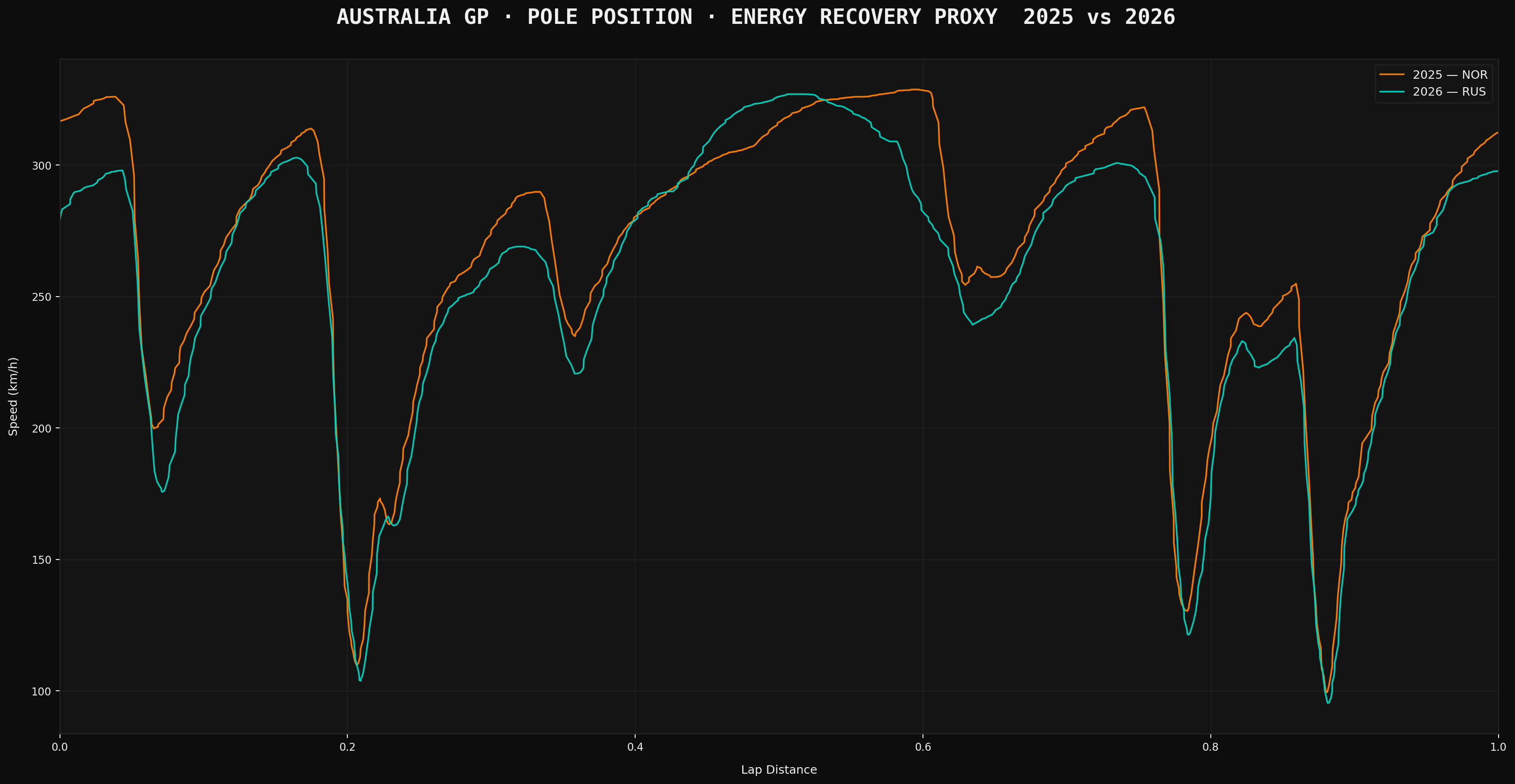
In 2025, the pattern is simple: speed builds steadily to the braking point, then drops sharply. In 2026, there are one or more steps where the car slows by around 50 km/h well before the braking zone, then recovers, then brakes normally. These steps are not the driver lifting. They are the power unit pulling energy from the engine to recharge the battery while the throttle is still fully open. That is superclipping.
Gear trace
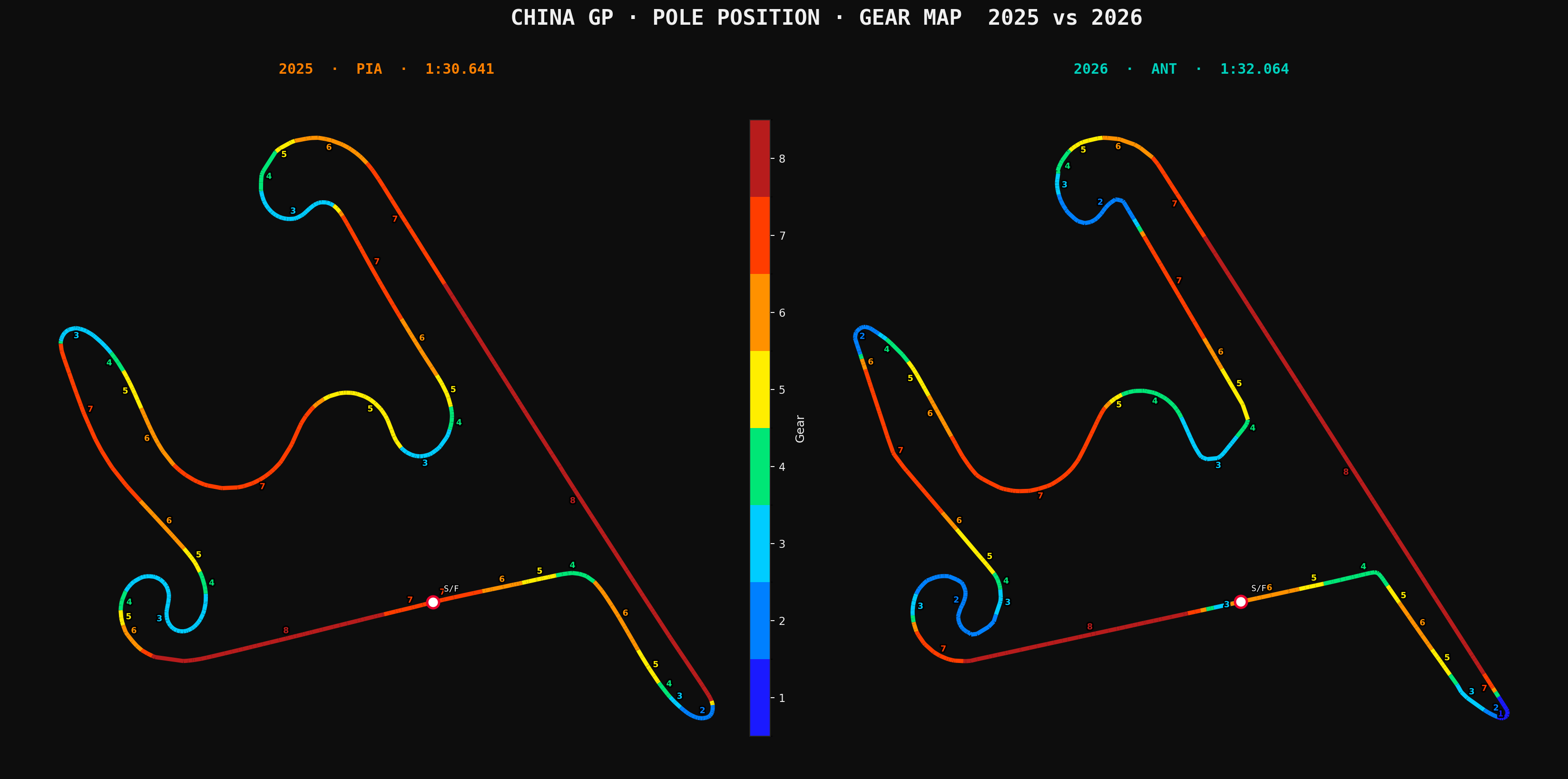
In 2025, drivers stay in relatively high gears through the corners. In 2026, they drop much lower. Without the MGU-H, the turbo loses speed every time the driver lifts off the throttle. Staying in lower gears keeps engine revs high, which keeps the turbo spinning and ready to deliver power on the way out of the corner. The driving style has changed completely, and so has the point at which drivers begin to brake and turn in.
What this looked like on track
The data tells one story. The first three races told another.
Formula 1 qualifying is supposed to be the purest expression of speed: one driver, one lap, nothing held back. In 2026, drivers were lifting, coasting and managing energy even on their flying laps, because the battery could not sustain full power for the entire lap. Fans were watching a time attack where the car was not always going as fast as it could.
Race starts brought a different problem. The absence of electric power below 50 km/h, combined with the complexity of the new pre-start sequences, made some cars accelerate off the line in unpredictable ways, creating hazards for the drivers directly behind them.
The most serious issue was speed differentials. Because different cars recharge and deploy at different moments, two cars approaching the same corner can be travelling at very different speeds, with no warning for either driver.
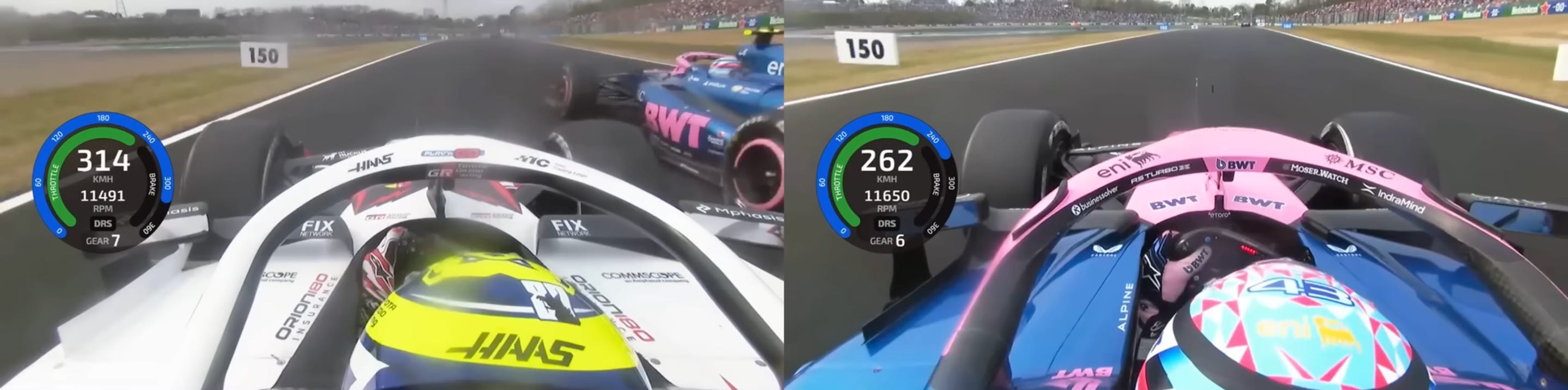
The clearest example came at Suzuka. Bearman was travelling at around 315 km/h when he had to swerve onto the grass to avoid Colapinto’s car, which was slowing to harvest energy. The speed difference between the two was around 50 km/h, not because one driver braked and the other did not, but because one car was deploying electrical power while the other was recharging. The impact registered 50G.
Finally, Overtake Mode created what drivers called yo-yo racing. Because one car can be at full electrical deployment while the car ahead is recharging, passes happen not through better driving but simply because the energy states of the two cars diverged at the right moment. A few seconds later, the positions can reverse for exactly the same reason.
The Miami reset
The FIA acted before the fourth race of the season, introducing a package of changes effective from the Miami GP.
Qualifying
The maximum energy that can be harvested per lap was reduced from 8 MJ to 7 MJ. Less energy to recover means less superclipping. The peak superclipping power was also raised from 250 kW to 350 kW, so when harvesting does happen, it is over faster. The FIA’s target is 2 to 4 seconds of superclipping per qualifying lap, down from what drivers were experiencing in the first three races. The number of races where alternative lower energy limits can apply was also increased from 8 to 12, giving the FIA more flexibility across the calendar.
Race
The same superclipping power increase (250 to 350 kW) applies in the race. To address the dangerous speed differentials seen at Suzuka, boost power is now capped at +150 kW, limiting the gap between a car at full deployment and one that is harvesting. MGU-K deployment is kept at 350 kW from corner exit to braking point, but limited to 250 kW elsewhere on the lap.
Race starts
A new low power start detection system was introduced: if a car shows abnormally low acceleration after the clutch is released, automatic MGU-K deployment is triggered. Cars affected display flashing rear and lateral lights to warn the drivers behind.
Wet conditions
Tyre blanket temperatures for intermediate tyres were increased to improve initial grip. Maximum ERS deployment in wet conditions was reduced to improve car control.
“To me it looks pretty terrible. If you go flat out on the straight in Monza and 400 metres before the end of the straight you have to downshift, flat out, because that’s faster… I think that’s not the way forward. [...] It looks like it’s going to be an ICE competition, so whoever has the strongest engine will have a big benefit.”
Max Verstappen, in 2023, talking about the 2026 regulations at the Austrian GP press conference